
Name
MoGasHero.png
default
To meet growing energy demands in eastern Missouri and Illinois, the Spire MoGas Pipeline will undergo a significant expansion to add more than 350,000 dekatherms per day of natural gas capacity, nearly doubling existing capacity to that section of the pipeline.

The expansion will add more than 350,000 dekatherms (Dth) per day of natural gas capacity, nearly doubling existing capacity to that section of the pipeline.

The project mainly consists of two new compressor stations in Scott and Jersey Counties, Illinois.

In Missouri, the project consists of a 2-mile, 20-inch lateral and delivery station in St. Charles County to serve new demand.
The Spire MoGas Pipeline Expansion Project will add compression and new delivery facilities to increase Zone 3 capacity by 362,000 dekatherms per day (Dth/d), allowing Spire to meet growing demand for natural gas in eastern Missouri and Illinois.
The expansion does not require the installation of new or larger pipe through privately owned properties.
Project expansion to provide dependable baseload power for customers.
default

The expansion will take place on Zone 3 of the MoGas Pipeline system, which connects the Rockies Express pipeline in Illinois to various delivery points and interconnects in Missouri, including Spire Missouri’s infrastructure in north St. Louis County. Zone 3 of the MoGas system was previously known as the Spire STL Pipeline before Spire merged operating certificates of the two pipelines early in 2026.
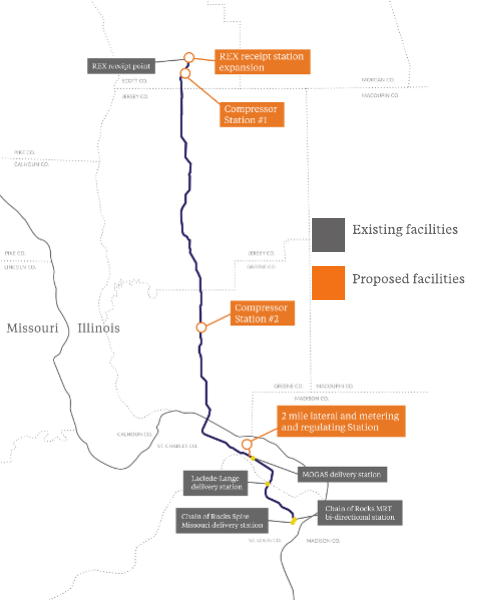
The project consists mainly of the construction of two new compressor stations. Each compressor station will be located on an approximately 10-acre site and will be encompassed by fencing for safety purposes and designed to blend into similar existing uses.
The facilities will house compressors and engines, gas conditioning equipment and all associated communication and controls equipment.
| Illini Compressor Station | Scott County, IL | New station; four 5,500-hp natural gas-fired compressor units (22,000 hp) |
| Monarch Prairie Compressor Station | Jersey County, IL | New station; three 5,500-hp natural gas-fired compressor units (16,500 hp) |
| REX Interconnect #2 | Scott County, IL | Expansion of Spire's existing meter and regulator station at the REX interconnect |
| New lateral, delivery station and valve site | St. Charles County, MO | New 2-mile, 20-inch pipeline and tap valve site serving the project's anchor shipper |
Spire launched a binding open season in September 2026, a formal step allowing prospective customers to make firm, contractual commitments for capacity. Now that the open season is complete, environmental and field surveys will take place.
Once complete, that information highlighting market support will be presented to the pipeline’s regulator, the Federal Energy Regulatory Commission (FERC), as part of a filed Certificate of Public Convenience and Necessity application.
Anticipated in-service date.
A natural gas compressor station is a facility that increases the pressure of natural gas to keep it moving efficiently through transmission pipelines.
For a project of this size, each station will be located on an approximately 10 acre site surrounded by fencing for safety purposes. The facility includes compressor units, cooling equipment, piping, control buildings and electrical equipment.
Modern natural gas compressor stations are designed with sound-reduction technologies to minimize sound impacts. Our plan is to use insulated buildings, mufflers and noise controls to do everything we can to minimize sound from the facility.
Unlike a buried pipeline easement, a compressor station occupies a defined surface area and will involve a minimal number of landowners. We will have discussions with these landowners to offer market-based compensation to place the compressor stations on their property.
The Project is subject to review and authorization by the Federal Energy Regulatory Commission (FERC), including environmental review under the National Environmental Policy Act (NEPA).
In addition, Spire will coordinate with Illinois and Missouri agencies and local governments on required permits and approvals.
After approval from the FERC, the MoGas Pipeline and STL Pipeline merged Jan. 1, 2026.
After Spire acquired the MoGas Pipeline in 2024, it made sense to streamline operations for the interconnected natural gas systems. By combining operating certificates of the MOGas Pipeline and the STL Pipeline, we were able to enhance operational efficiency and simplify customer interactions.
The consolidation also established a single FERC Gas Tariff and operating certificate to unify regulatory reporting. In addition, it created a more seamless experience for customers that would allow for a single transportation agreement covering multiple system zones.
This project is designed to meet the overall growing energy needs of eastern Missouri and Illinois and has been in discussion since before the pipeline was put into service in 2019. It is not attached to a specific project like a data center.